
Tea, cinema and literature have been the uniting forces for Indians from Kashmir to Kanniyakumari for generations. While many people drink tea as part of their daily routine, only a few realise its profound impact on our lives, the cinema we watch and the literature we read. To know the effect of this beverage on cinema and literature, one must read this blog.
If there are a few things that can unite Indians, transcending cultures, languages, and boundaries, it has to be cinema and tea. A cup of tea shared on a train journey, becomes a bridge for strangers to bond, making their travels more enjoyable. Both tea and cinema, though rooted in colonial times, have evolved to become integral parts of India’s vibrant culture, symbolizing connection and shared experiences.
Literature, too, has always been an essential part of Indian culture, with stories, poetry, and philosophies passed down through generations. Sipping tea while reading a book, newspaper, or magazine is a cherished daily ritual for many, blending the simple joy of tea with the deep connection to knowledge and stories.
Whether it’s enjoying a thrilling novel or catching up on the latest news, tea becomes the perfect companion, making moments of solitude more enriching. Together, tea, cinema, and literature form a beautiful trifecta, embodying the essence of India’s cultural fabric and the timeless tradition of coming together over a cup of tea.
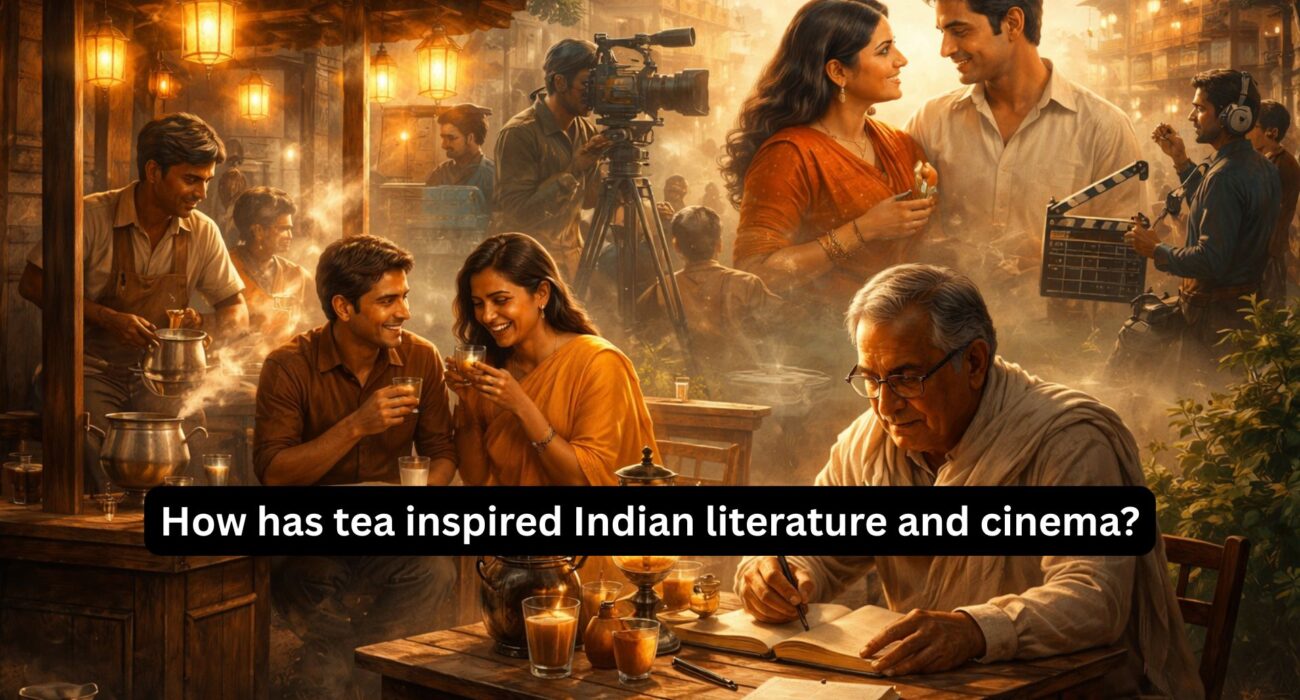
Not only has tea been an accompaniment to literature and cinema, but it has also inspired literature and cinema in India. Let us see how has tea inspired India’s literature and cinema.
Tea in Indian cinema
Tea, the beverage that has been a staple across the subcontinent, has deeply influenced cinemas across the subcontinent, becoming a recurring motif that reflects culture, connection, and transformation.
In Bollywood, the earliest reference to tea is found in the film Rahi (1953) featuring Dev Anand and Nalini Jaywant which deals with the hardships of workers in the tea estates, highlighting their struggles and aspirations. This film is among the first to depict tea not just as a beverage but as a central element influencing the narrative and setting.
Another instance, when the tea stall is important as a place for shaping the narrative is the 1975 film Deewar, where the main protagonist Vijay(played by Amitabh Bachchan) asserts his defiance and resilience while sipping tea at a roadside stall. This moment underscores the significance of tea stalls as communal spaces where pivotal interactions occur.
In Tamil cinema, the earliest reference to tea is found in a film named Sathi Leelavathi(1936), where the main protagonist, after losing everything decided to work in a tea estate in Sri Lanka.
Another mention of tea in Tamil cinema is found in the 1995 film Baasha, where a tea stall serves as the central location of Manikam’s (played by Rajinikanth) meetings with the commoners to understand their problems.
In the Telugu cinema, a reference towards tea stalls is shown in the film George Reddy(2015), the biopic of the student leader George Reddy as the place where people from diverse views meet and iron out their differences.
In the Gujarati cinema, the tea kettle(chai ni kitlis) has always acquired a central place in almost every film, however the most recent reference to tea is from the 2012 film Kevi Rite Jaish where the tea stall is central to all the conversations of the film.
Tea in Indian literature
The oldest mention of tea in Indian literature finds its reference in Ayurveda, where tea though not mentioned directly, has references to herbal tea and the tea plant(Camellia Sinensis) was mentioned as a medicine. The bitter taste of spices had to be masked with a sweet and milky taste and hence tea was born as a medicine, not a daily drink.
During the Mughal era, there are references to the drink being brought by European travellers, traders and ambassadors to the court of Jehangir, the fourth Mughal ruler.
During the colonial era, the drinking of tea had been popularised. British documents mentioned that the Singpho tribe of present-day Assam had been consuming a drink similar to tea.
Rabindranath Tagore, in his novel Nashtanirh, tea plays a subtle yet significant role as a cultural element that highlights intimacy, hospitality, and the evolving social norms of the late 19th century Bengal Renaissance. Tea is woven into the everyday life of Charulata, the protagonist, and serves as a backdrop for her interactions with her husband Bhupati and her cousin-in-law Amal. The presence of tea in the narrative reflects the influence of British culture on the urban, educated Bengali elite during that era. Tea-drinking scenes are not only symbolic of the social settings of the time but also help in character development and advancing the plot.
In the post-independence literature, tea plays a central part. Some examples include:
– In Malgudi Days by R.K. Narayan, tea is a backdrop for many conversations and daily life, symbolizing the simplicity and warmth of small-town India.
-In the novel Nectar in a Sieve (1954), the author Kamala Markandaya subtly weaves tea into the rural-urban divide, depicting it as a marker of changing lifestyles in post-colonial India.
– In the book, Interpreter of Maladies (1999) by Jhumpa Lahiri, tea is depicted as a cultural constant that bridges the gap between India and the lives of Indian immigrants in the West.
-In the iconic short story Maare Gaye Gulfam by Phanishwarnath Renu, tea stalls subtly incorporate tea as the hubs of rural life, capturing the essence of small-town India.
-In Adha Gaon by Rahi Masoom Raza, tea highlights the changing dynamics of rural and urban India, symbolizing the influence of modernization on traditional communities.
Tea has transcended its role as a mere beverage to become a cultural and artistic symbol in Indian literature and cinema. Its ubiquitous presence in the lives of Indians has made it a natural muse for writers and filmmakers, serving as a metaphor for warmth, connection, and reflection. This humble drink has also captured India’s socio-political and cultural transitions, becoming a unifying thread across diverse narratives. By bridging tradition and modernity, tea continues to inspire stories that resonate deeply with audiences, making it not just a part of life but a storyteller in itself.